The Quick Diagnosis: If your EP pallet jack is hard to push, pulls to one side, or makes grinding noises, the load wheels are shot. The most likely cause is a seized bearing or chunked polyurethane. You need a new load wheel kit.
Symptoms & Identification
Before you grab tools, confirm you're on the right track. If the operator is reporting any of these, you're looking at a load wheel problem.
- Hard to Push/Pull: Feels like you're dragging an anchor. This is a classic sign of seized bearings or a major flat spot.
- Pulls Sharply to One Side: One wheel has failed, and the other is doing all the work, causing the jack to veer off course.
- Grinding or Scraping Noise: The bearing has disintegrated, and you're hearing metal-on-metal.
- Bumpy or Rough Ride: The polyurethane tread is chunked, pitted, or missing pieces, creating a "thump-thump-thump" as it rolls.
Tools Required
- Heavy-Duty Floor Jack or Transmission Jack
- Jack Stands or Solid Hardwood Blocks
- Heavy-Duty Snap Ring Pliers
- Pin Punch Set
- Dead Blow Hammer or Sledgehammer
- Penetrating Lubricant (e.g., PB B'laster)
- Safety Glasses
- Wheel Chocks
Safety Warning
Chock the steer wheel securely on both sides before you lift the jack. If the unit rolls while your hands are in the linkage, you will suffer a severe crush injury. Never work under a load supported only by a hydraulic jack.
The Technical Guide
Step 1: Secure the Jack and Lift the Forks
Chock the steer wheel. Position your floor jack under a solid point of the linkage assembly, not the thin sheet metal. Raise the forks just enough for the load wheels to clear the floor by an inch. Immediately slide hardwood blocks or jack stands under the forks near the wheel assembly. Slowly lower the jack until the forks rest solidly on the blocks. Give the forks a firm shake to ensure they are stable.
Step 2: Remove the Old Wheels
Grab your heavy-duty snap ring pliers and remove the retaining clips on both ends of the axle pin. These can fly off under tension, so wear your safety glasses. Once the clips are off, soak both ends of the axle pin with penetrating lubricant. Let it sit for 10-15 minutes. Corrosion is the enemy here.
Select a pin punch slightly smaller than the axle diameter and give it a few sharp, solid strikes with your hammer to drive the pin out. If it's seized, apply more lubricant and more time. Do not use heat, as it can damage the fork linkage. Once the pin is out, the old wheels will drop free.
Step 3: Clean and Inspect the Assembly
With the old wheels out, use a wire brush to clean all rust and grime off the axle pin. If the pin is bent or severely pitted, replace it. Inspect the bores in the fork linkage where the axle passes through. If the holes are worn into an "egg" shape, the entire linkage is worn out and new wheels will fail prematurely. Clean all debris, old grease, and plastic wrap out of the wheel housing.
Step 4: Install the New Load Wheels
Apply a light coat of grease inside the new wheel bearings and a thin layer of anti-seize to the clean axle pin. Slide one new wheel into the linkage, making sure any seals or bearings are oriented correctly. Feed the axle pin through the linkage, the first wheel, the center support, and the second wheel. You may need to use a dead blow hammer to gently tap it through.
Center the pin and install new snap rings on both ends. You should feel a solid "click" as they seat in their grooves. Never reuse old snap rings.
Step 5: Verify the Repair
With the jack still on blocks, give each wheel a spin by hand. They should rotate smoothly and silently. Watch for any wobble, which indicates a bent pin or improper seating.
Lower the jack and remove the chocks. Find a pallet weighing 1,000-1,500 lbs and move it. The jack should roll easily and track straight. Listen for any groaning or popping under load.
Note: Components may vary by Gen 1 vs Gen 2 series. Verify with your parts manual.
The Part You Need
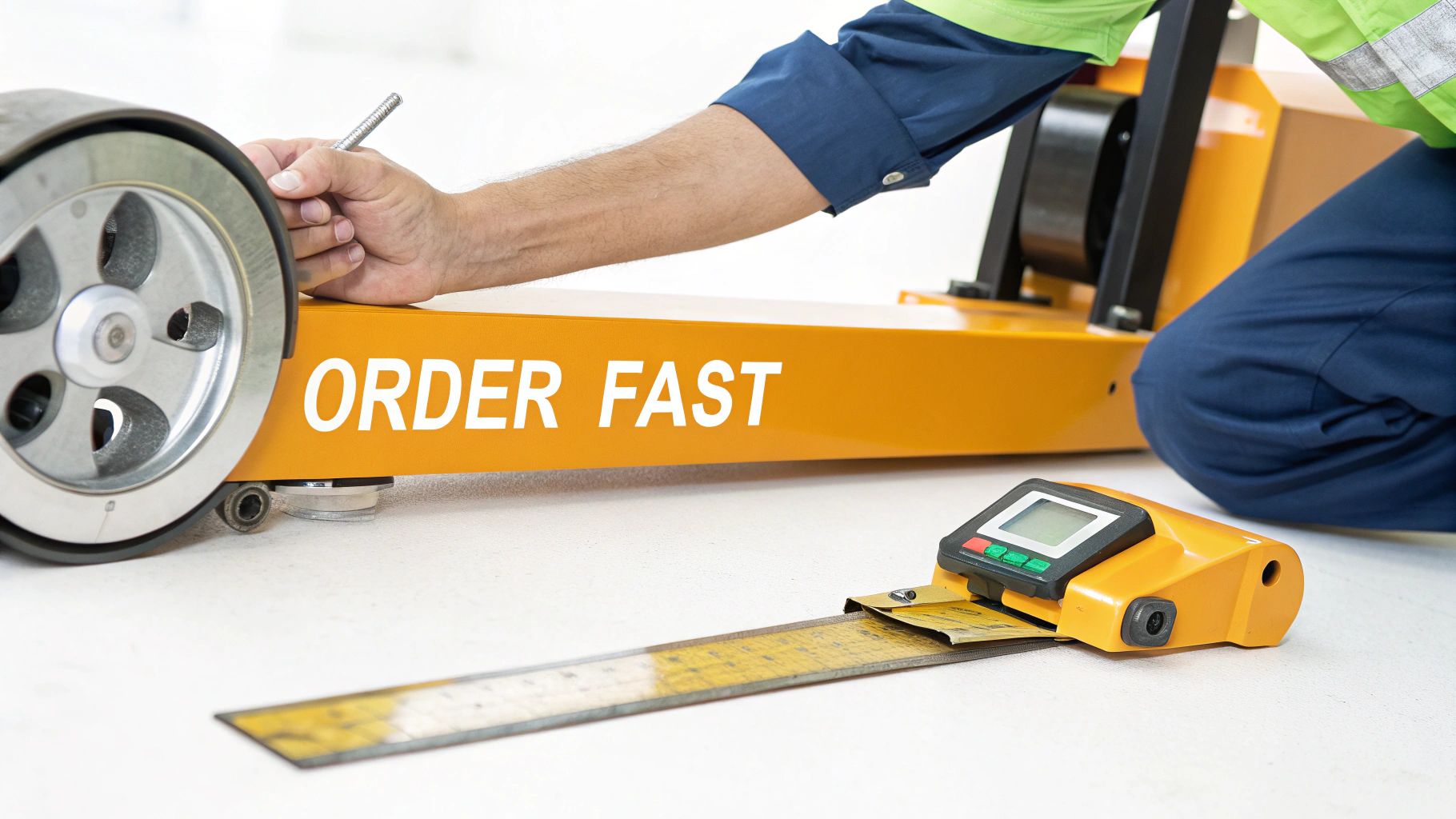
To order the correct replacement, you need three measurements from an old wheel using calipers: Wheel Diameter, Wheel Width, and Bearing Inside Diameter (ID). Polyurethane wheels are the standard for most concrete warehouse floors.
The biggest villain in any shop is downtime, and waiting 6-8 weeks for a dealer to ship a common wear part from China is unacceptable. China Lift Supply stocks high-quality, OEM-compatible load wheel kits for EP pallet jacks in the US, ready for same-day shipping.
Can't wait 6 weeks for this part? We have it on the shelf in Kansas. Check the price and availability here: [Link Placeholder].