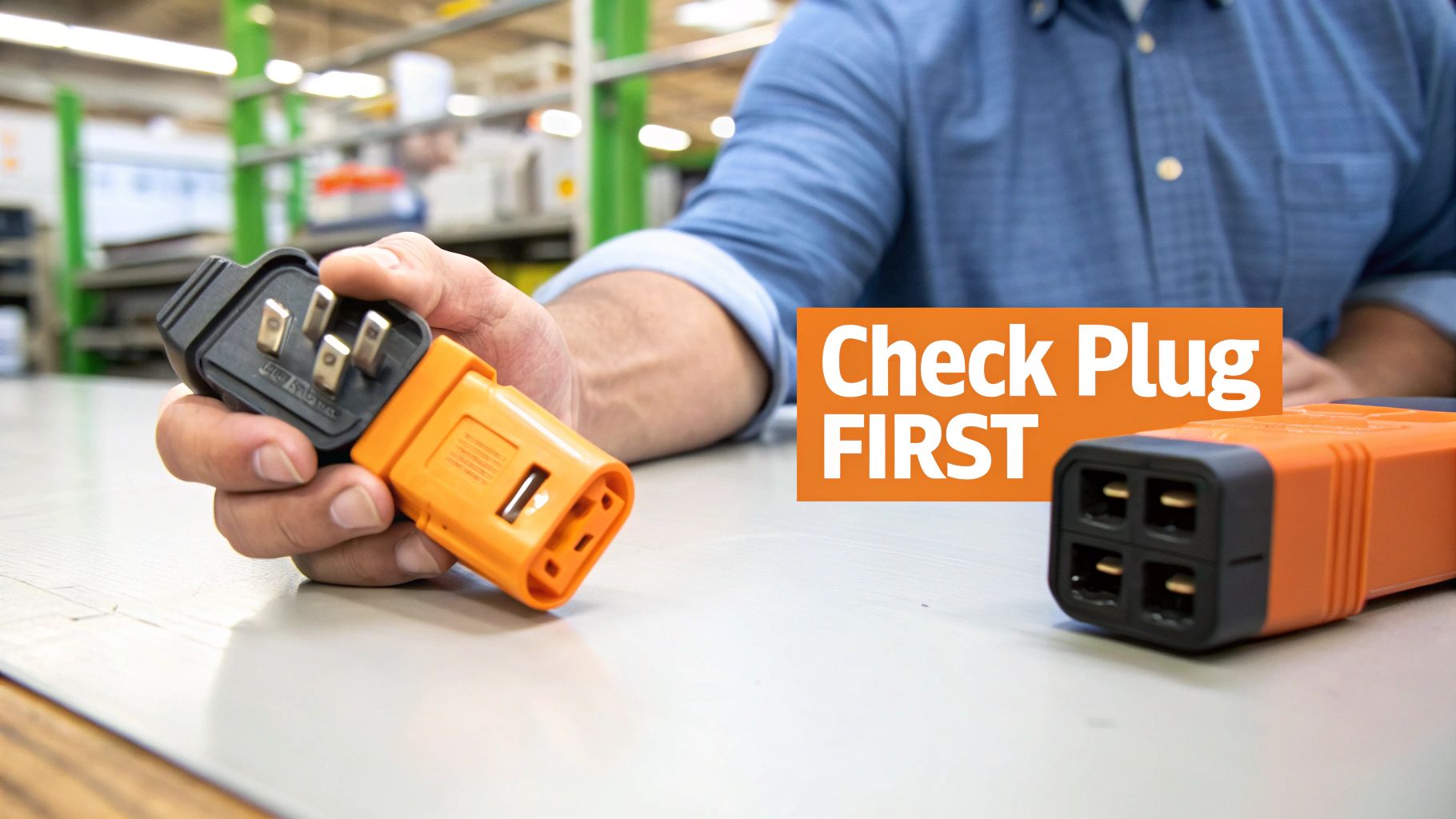
If your Chinese lift or pallet jack won't take a charge, the plug is the first place to look. Nine times out of ten, a loose, melted, or corroded connector is the root cause. While mechanics use "Anderson" as a catch-all, the specific part you're dealing with is the gray SB50 connector. It's the 50-amp industry standard for 24V-48V equipment from brands like Heli, Dingli, and LGMG. Using a cheap knock-off is a recipe for arcing and downtime.
The Quick Diagnosis A charger that won't activate, intermittent charging alarms, or visible melting on the plug housing all point to a bad connection. The fix is a new, high-quality SB50 connector kit. Do not try to repair a melted plug; it's a fire hazard.
Symptoms & Identification
Before you cut wires, confirm the plug is the problem. Look for these signs:
- Charger Won't Activate: The charger fan never starts, and status lights stay on standby. The charger can't sense a complete circuit through the faulty plug.
- Intermittent Charging Alarms: The charger cycles on and off, or the machine throws charging fault codes. This happens when a poor connection breaks and remakes itself due to heat or vibration.
- Visible Arcing or Melting: Look for black, sooty marks around the contact pins or deformed plastic on the plug housing. This is the smoking gun.
- Excessive Heat: After a charge cycle, the plug is too hot to touch. A good connection gets warm, but a bad one gets scorching hot from electrical resistance.
If you see these symptoms, especially visible melting, the plug must be replaced.
Tools Required
- Hydraulic or Long-Handle Mechanical Crimper: For 6-8 AWG cable. A cheap automotive crimper will not create a secure connection and will lead to failure.
- Heavy-Gauge Wire Strippers
- Multimeter
- Heat Gun & Adhesive-Lined Heat Shrink Tubing
Safety Warning CRITICAL ARC FLASH HAZARD: High-current DC systems can create a violent, explosive arc. Before cutting any power lead, disconnect the main battery pack connector from the machine. Use your multimeter to verify zero voltage across the leads you intend to cut. Always wear safety glasses.
The Technical Guide: Anderson vs. SB50
The core issue isn't just the brand name; it's the specific model and its voltage keying. Anderson Power Products (APP) is the original manufacturer, but the SB50 model is the specific part you need. The market is flooded with "Anderson-style" knockoffs that cause intermittent charging issues because they lack the precise tolerances and quality materials of a genuine connector.
SB50 vs. Generic 'Anderson-Style' At a Glance
This table cuts through the noise and shows you how to identify a proper SB50.
| Attribute | SB50 Connector (The Standard) | Generic 'Anderson-Style' Connectors (Potential Mismatches) | | :--- | :--- | :--- | | Markings | Clear "APP" logo and "SB50" model number molded into the housing. | Often completely unmarked, may have weird logos, or will lack any specific model identifiers. | | Voltage Keying | Precise, color-coded housings (e.g., Gray for 24V, Blue for 36V) that physically prevent cross-connection. | Might use similar colors but often lack the precise mechanical keying, allowing for dangerous voltage mismatches. | | Contact Quality | Silver-plated copper contacts for superior conductivity and corrosion resistance. | Typically use cheaper tin-plated contacts that oxidize, increasing resistance and heat over time. | | Housing Material | High-impact polycarbonate that resists chemicals, UV damage, and temperature extremes. | Can be made from cheaper plastics (like ABS) that get brittle and crack with age and shop use. |
Why the SB50 is the Fleet Standard
Fleet managers standardize on the SB50 for one reason: uptime. When every 24-48V machine from Heli, Dingli, and LGMG uses the same gray SB50 plug, charger deployment is simple. Operators don't hunt for adapters (which are just another failure point), and technicians can troubleshoot connection issues faster. It eliminates the risk of an operator connecting a 48V charger to a 24V pallet jack—a mistake the SB50's mechanical keying makes impossible.
A standardized fleet also means a smaller parts inventory. Instead of stocking a half-dozen different connectors, you stock one. Your tech will always have the right part on the service truck to get a machine back in service in minutes.
The Part You Need
Don't waste time trying to salvage a melted or corroded plug. The solution is a new SB50 connector kit, which includes the housing and two silver-plated copper terminals. The biggest hurdle for techs is getting the part quickly. Dealer lead times for Chinese brands are notoriously slow, often 6-8 weeks for a simple part.
China Lift Supply stocks high-quality SB50 connector kits in the US for same-day shipping, eliminating the dealer wait time.
<iframe width="100%" style="aspect-ratio: 16 / 9;" src="https://www.youtube.com/embed/oNyYYfxmlG8" frameborder="0" allow="autoplay; encrypted-media" allowfullscreen></iframe>Installation Guide: Step-by-Step
A bad crimp is a future failure. Follow these steps exactly.
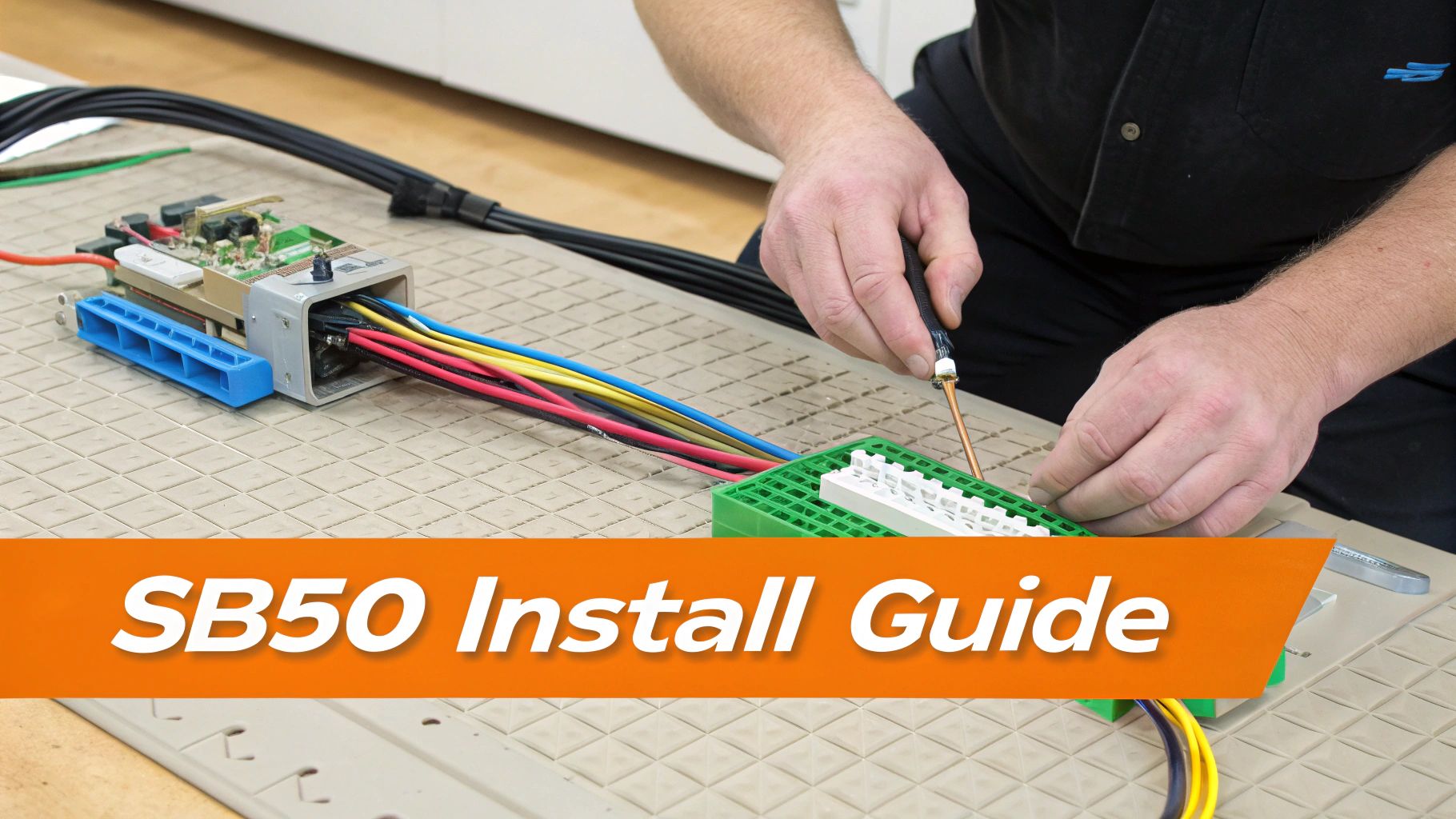
- Verify Polarity: Before cutting, use your multimeter to confirm positive (+) and negative (-) on the old plug. Mark the positive cable with red tape. Reversing polarity will damage the charger or the machine's controller.
- Cut and Strip: Make a clean cut behind the damaged plug. Carefully strip about 1/2 inch (13mm) of insulation. Do not nick the copper strands.
- Crimp the Terminals: This is the most critical step. Use a proper hydraulic or long-handle mechanical crimper. The connection must be tight enough that you cannot pull the wire out by hand. A loose crimp generates heat and is guaranteed to fail.
- Insert Pins into Housing: Pay close attention to the polarity markings (+ and -) inside the new SB50 housing. Push the positive terminal into the (+) slot and the negative terminal into the (-) slot. You must hear a distinct "click" as the terminal locks into place.
- Final Tug Test: Give both wires a firm pull to ensure they are locked securely. They should not move. Seal the connection with adhesive-lined heat shrink tubing for a weatherproof finish.
Common Questions from the Shop
- Can I use an SB175 plug instead? Absolutely not. The SB175 is a much larger connector for heavy-duty electric forklifts. The housings will not mate, and the pins are for a different wire gauge. Stick with the SB50 for 24-48V scissor lifts and pallet jacks.
- Why are there different colors?
The colors are a critical safety feature, mechanically keyed to a specific voltage. This physically prevents you from connecting a 24V charger to a 48V machine.
- Gray: 24V (Most common for scissor lifts/pallet jacks)
- Blue: 36V
- Red: 48V If you have to force it, you are making an expensive mistake.
- Note: Components may vary by Gen 1 vs Gen 2 series. Verify with your parts manual.
Can't wait 6 weeks for this part? We have it on the shelf in Kansas. Check the price and availability here: China Lift Supply.