
If your Sinoboom 1932ME is stuck in the air with a total power failure, the only way down is the emergency lowering manual override. This is a critical safety feature. If the operator is stranded, you don't have time for a manual—you need the solution now.
The Quick Diagnosis If the platform and ground controls are completely dead—no lights, no sound, no joystick response—you have a total power loss. The immediate action is to locate the red, T-shaped handle on the chassis near the ground controls and pull it to mechanically lower the platform.
Symptoms & Identification
Before you pull that handle, confirm you're dealing with the right problem. The operator will see:
- Zero Joystick Response: The platform joystick is completely dead.
- Blank Control Box Display: The LCD or any indicator lights are off.
- Ground Controls are Inoperative: Toggling the ground control switches does nothing.
- Complete Silence: The machine is dead quiet. No clicks from contactors, no hum from the hydraulic pump.
Confusing a single function failure (e.g., lift works but drive doesn't) with a total power loss is a common mistake. The override is the last resort for when the entire electrical system is offline.
Tools Required
- Heavy-Duty Wheel Chocks
- High-Visibility Vest
- Safety Glasses
Safety Warning
Chock wheels on both sides before touching the override handle. Even a slight incline can cause the machine to roll once hydraulic pressure is released, creating a new, uncontrolled hazard.
The Technical Guide (Step-by-Step)
You've confirmed a total power loss. The site is secure. Now, let's get that operator down.
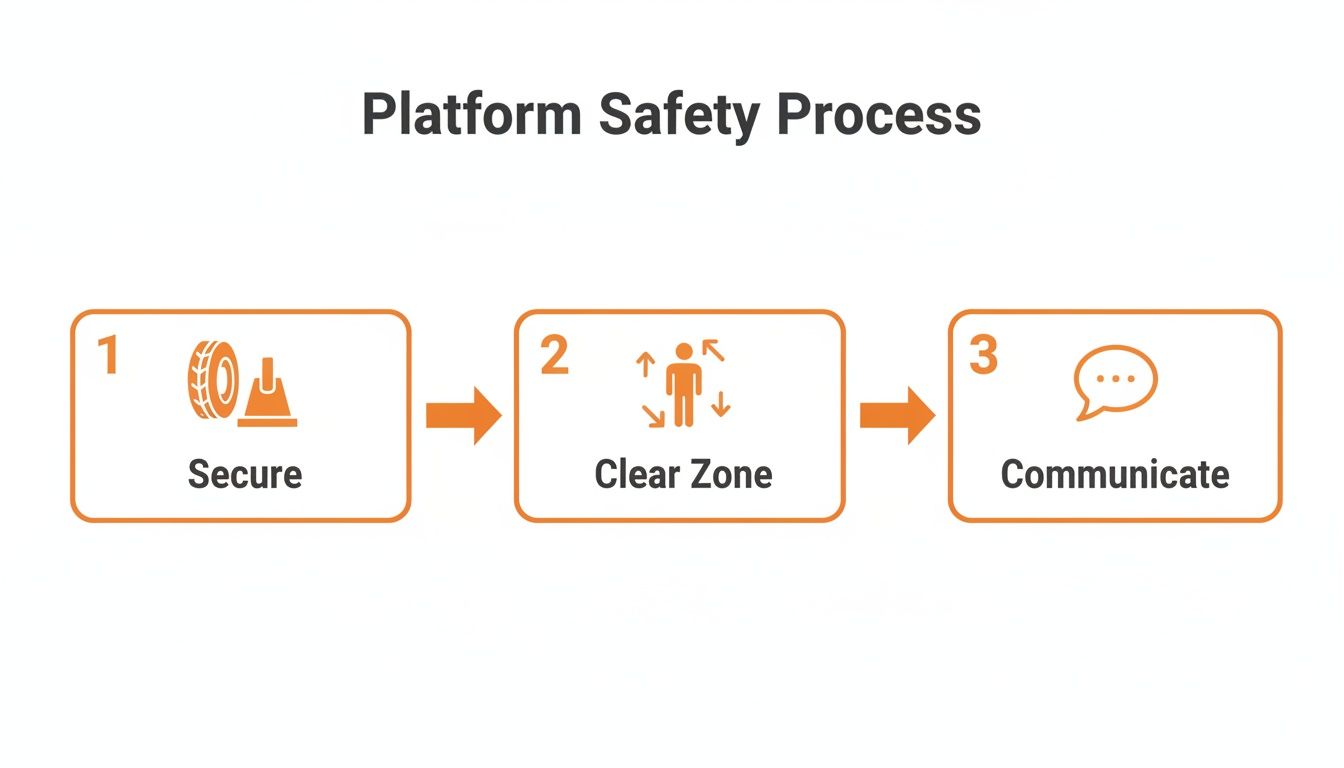
Step 1: Secure the Area
This isn't a suggestion; it's a requirement.
- Chock the Wheels: Lock the machine in place with heavy-duty wheel chocks.
- Establish an Exclusion Zone: Use cones or tape to create a perimeter around the lift. No one walks under that platform. The safe zone should be at least 1.5 times the machine's raised height.
- Communicate: Get eye contact with the operator. Tell them, "I'm bringing you down now. It will be slow. Stay in the center and hold the rails." Clear, calm communication is as important as the mechanical steps.
Step 2: Locate and Actuate the Manual Override
- Find the T-Handle: Locate the red T-handle on the side of the chassis, usually near the ground controls. It's often recessed to prevent accidental activation.
- Get a Firm Grip: Plant your feet and get a solid grip on the handle.
- Pull and Hold: Pull the handle straight out with a firm, steady motion. Do not jerk it. You must hold the handle out for the entire descent. If you let go, the spring-loaded valve will slam shut and the platform will stop instantly.
Step 3: Monitor the Descent
- Listen for the Hiss: The moment you pull the handle, you should hear the hiss of hydraulic fluid returning to the tank. This is normal.
- Watch the Speed: The platform should descend at a controlled rate of 1 to 2 feet per second.
- Scan for Obstructions: Keep your eyes on the scissor stack for any potential snags. If you see a problem, immediately release the T-handle. The platform will stop, allowing you to assess the situation.
Note: Components may vary by Gen 1 vs Gen 2 series. Verify with your parts manual.
Step 4: Post-Descent Actions
- Wait for Full Lowering: Only release the handle after the platform is fully lowered and resting on its stops.
- Tag Out the Machine: The emergency is over, but the machine is still broken. Immediately apply a "Do Not Operate" tag to both control stations.
- Inspect the Override System: Before you start electrical diagnosis, inspect the override handle, cable, and linkage for any damage that occurred during the descent.
- Begin Troubleshooting: Now you can break out the multimeter and find the root cause of the power failure—dead batteries, a failed main contactor, or a severed cable.
For detailed electrical schematics, our Sinoboom 1932ME troubleshooting guide is your next stop.
The Part You Need
If the override cable snapped or the handle assembly is damaged, the machine is hard-down until it's fixed. This is a non-negotiable safety component. The most common failures are the override cable itself or the T-handle assembly.
The villain is downtime. Waiting for a dealer to get a part from the factory in China means 6-8 weeks of a machine sitting idle. The hero is having the part on the shelf in the US.
China Lift Supply stocks the OEM-compatible Sinoboom 1932ME replacement parts, including emergency lowering override components, in the United States to avoid that crippling dealer lead time.
Questions From the Field
Here are the straight answers to common questions about the Sinoboom 1932 emergency lowering manual override.
<iframe width="100%" style="aspect-ratio: 16 / 9;" src="https://www.youtube.com/embed/DNt93pPvJwo" frameborder="0" allow="autoplay; encrypted-media" allowfullscreen></iframe>What if the handle is stuck or pulls with no tension?
- No Tension: The cable has snapped or disconnected from the valve. This is the most common failure.
- Stuck Solid: The valve plunger is seized from corrosion or the linkage is bent. This happens when the system isn't tested regularly.
Can I use the override if the machine has power but won't lower?
No. The override is for total power failure only. If you have power, you have an electrical or hydraulic fault that needs proper diagnosis, not a bypass. Using the override masks the real problem.
What happens if I let go of the handle mid-descent?
The platform will stop instantly. The valve is spring-loaded to fail-safe in the closed position. This is a "pull-and-hold" system.
How often should the override be tested?
The cable tension should be checked during the daily pre-use inspection. A full function test (raising the platform a few feet and lowering with the override) should be part of your quarterly or annual PM service. Finding a seized cable during maintenance is an inconvenience; finding it during a real emergency is a crisis.
Can't wait 6 weeks for this part? We have it on the shelf in Kansas. Check the price and availability here: [Link Placeholder].